


Patterns: what comes next?
Patterns and number relationships
Recognising and continuing repeating and growing patterns of symbols, colours, pictures and numbers, and spotting the piece that breaks a pattern.
This browser is too old for Teach.cy, and the exercises will not work properly. It needs at least iPadOS or iOS 16.4, Chrome or Edge 117, Firefox 121 or Safari 16.4. Update the device or open Teach.cy on another one. Supported devices
Skip to contentFrom number sense and quantities to operations, times tables and fractions, with pictures and in small steps. You start at the level that suits the child and move on when they are ready.
Each set says exactly what it practises and what the child needs to know already, so you can choose by the child and not by age alone.
49 exercise sets · Ages and years are a guidePage 2 of 2
Patterns and number relationships
Recognising and continuing repeating and growing patterns of symbols, colours, pictures and numbers, and spotting the piece that breaks a pattern.
Time and money
Money in practice: paying the exact price with coins and notes, in more than one way, and choosing what I can buy with my money.
Fractions and parts of a whole
What per cent means, a percentage of an amount, and problems with discounts and price rises.
Shapes and geometry
Finding the perimeter and area of rectangles, squares, triangles and parallelograms, and solving problems with shapes.
Solving short problems
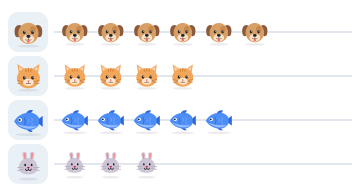
Reading a pictogram and a bar chart: the most and the fewest, one value, how many more and how many altogether.
Time and money
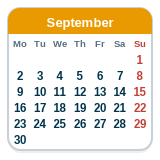
Reading a calendar: days and months in order, yesterday and tomorrow, and the seasons.
Time and money
Showing a time on an analogue clock by turning the hands, from o’clock to five-minute times, and finding when something ends.
Shapes and geometry
Naming circles, squares, rectangles, triangles and rhombuses, and comparing their sides and corners.
Addition, subtraction, multiplication and division
A first look at division: sharing equally, grouping, the answer and the remainder, with pictures and short problems.
Solving short problems
Solving short addition and subtraction problems from everyday life: understanding, choosing the numbers and calculating.
Counting and making quantities
Showing a number with counters, as two parts, as jumps on a number line and as a number sentence, and explaining how.
Solving short problems
Showing a problem before solving it, solving it with jumps, choosing the solution that fits and finding the mistake in one.
Patterns and number relationships
Counting forwards and back in ones, 2s, 5s and 10s to 100, and finding the numbers missing from a row.
Series · 2 sets
Addition, subtraction, multiplication and division
Time and money
Choosing the unit that fits for length, mass, capacity and time, and converting with whole numbers and decimals.
Time and money
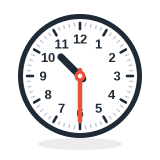
Telling the time to the hour and half past on an analogue clock, and linking it to digital times and the order of the day.